


Hearing Research
Below, we explain the study in plain language: what the team did, which four genes came up, what a polygenic risk score is, and why nobody can order a test for these genes today. We also say what the study cannot tell you. It cannot predict your own future hearing, and the authors do not claim it can.
We are an audiology practice with offices in San Mateo and San Carlos, and we took no part in this research. We wrote this page from the study's citation and from Neuroscience News' report of it. JAMA's own page blocked our automated check, so we have not read the full text. We will update this page if anything below turns out to be wrong.
At a glance
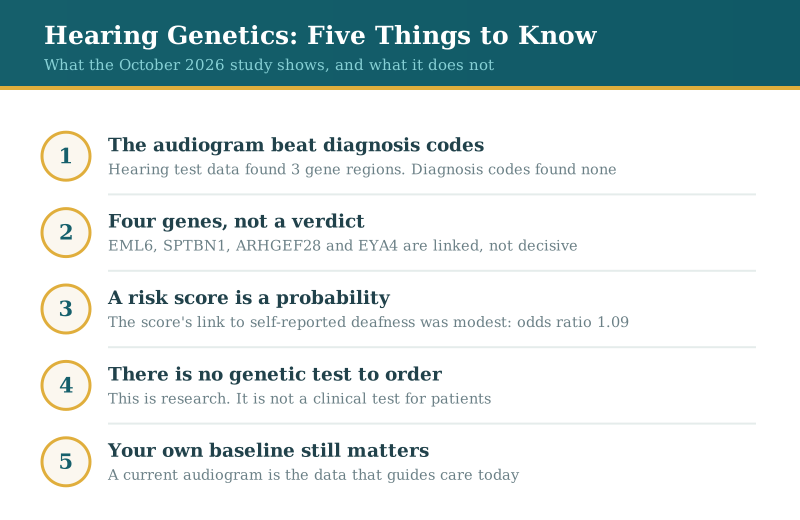
- A Vanderbilt-led genetic study used audiogram data from 16,057 people and found three regions of DNA that map to four genes: EML6, SPTBN1, ARHGEF28 and EYA4.
- A second analysis, built on diagnosis codes for 10,164 people with hearing loss and 51,305 comparison people, found no significant regions.
- A risk score built from the audiogram analysis had a modest link to self-reported deafness in a separate group of people (odds ratio 1.09). It is a research tool, not a diagnosis.
- No clinic can order a genetic test for these genes today. A current hearing test is still the best way to learn where your hearing stands.
What the researchers did
The team ran two genome-wide association studies, called GWAS. A GWAS scans the DNA of many people and looks for gene variants that show up more often alongside a trait. Both studies used whole-genome data from BioVU, Vanderbilt's biobank, in people of European ancestry. The first defined hearing loss by diagnosis codes in the medical record. It compared 10,164 people with those codes to 51,305 people without them. The second used audiometric data instead: the average of three pure-tone thresholds in each person's better ear, for 16,057 people. Only the second description turned up anything significant.
Why the audiogram beat diagnosis codes
The audiogram analysis found three genome-wide significant regions of DNA. The diagnosis-code analysis found none. The team also estimated heritability, which is the share of differences in hearing that common DNA variants account for. It came out at 11.78 percent for audiogram data and 2.90 percent for diagnosis codes. Audiologist Andrea DeFreese, one of the authors, said the approach lets researchers use “a more precise phenotype for hearing loss instead of diagnostic codes that can be inaccurate.” A code says a person has hearing loss. It does not say how much, at which pitches, or in which ear. An audiogram does, so the genetic signal is easier to see when researchers feed in measurements.
| Diagnosis-code analysis | Audiogram analysis | |
|---|---|---|
| How hearing was defined | ICD-9 and ICD-10 diagnosis codes in medical records | Average of three pure-tone thresholds in the better ear |
| People studied | 10,164 with codes and 51,305 without | 16,057 participants |
| Estimated heritability | 2.90% | 11.78% |
| Significant DNA regions | None | Three, mapping to four genes |
| Risk score and self-reported deafness (All of Us) | Odds ratio 1.00, not significant | Odds ratio 1.09, significant |
The four genes, in plain words
The three regions map to four genes: EML6, SPTBN1, ARHGEF28 and EYA4. The word to hold on to is linked. These are places in the genome where variation tracks with hearing results across thousands of people. They are not “the hearing loss genes,” and a variant near one of them does not mean you will lose hearing. EYA4 has a longer research history, because earlier studies tied changes in EYA4 to an inherited form of hearing loss. We will not describe what the other three genes do. The summaries we could read do not say, and we would be guessing. Common hearing loss usually has many contributing factors, not one faulty gene.
What a polygenic risk score is, and is not
A polygenic risk score adds up the small effects of many gene variants into one number. Think of a weather forecast: it speaks in odds, not outcomes. The team built scores from both analyses and tested them in the NIH All of Us research program, where people had reported whether they were deaf. The score built from audiogram data was significantly associated with self-reported deafness, with an odds ratio of 1.09 (95 percent confidence interval 1.07 to 1.12). The score built from diagnosis codes was not (odds ratio 1.00). An odds ratio of 1.09 is a modest association. It cannot tell any one person whether they will lose hearing, and nobody should use it that way.
What the study cannot tell us
Every study has limits, and this one says so. It drew on a single medical center and on people of European ancestry, so the results may not hold for everyone. The check in All of Us used self-reported deafness, not audiograms. The error margins around the heritability estimates are wide. And the hopeful talk about earlier screening and tailored treatments is a goal, not a service. Co-author Taha Jan said genetics is becoming increasingly relevant for precision therapy. That describes a direction. Our page on gene therapy and the future of hearing loss treatment explains why the road from a gene to a treatment is long.
Why this makes your own audiogram worth keeping
The study backs up something audiologists already believe: a measured audiogram is valuable data. It records your hearing today, pitch by pitch, and a series of them shows how fast things change. Our guide to reading your audiogram explains what the lines and symbols mean. If you have never had a full test, a baseline gives future you something to compare against. If you have an old audiogram from another clinic, bring it. Our hearing testing page lists what we measure, and what to expect at a hearing test walks through the visit. Our pages on the different ways audiologists test for hearing loss and on how to get your hearing checked explain the options.
Can you get a genetic test for this?
Not from us, and not as a routine clinical test for these four genes. The study is a research finding, and the risk score is a research tool. Clinical genetic testing for hearing loss is a separate topic. A physician or genetic counselor orders it, most often when a child is born with hearing loss or when loss starts early and runs in a family. If that sounds like your family, tell your audiologist. We can talk it through and refer you. For most adults, the practical steps are the same as before: a current hearing test, protecting your ears from loud noise, and treating hearing loss when it appears.
Who should not wait for a baseline
Some signs call for a prompt evaluation, not a routine check. They include sudden hearing loss in one or both ears, hearing that is clearly worse on one side, dizziness, ear pain or drainage, and ringing in one ear only. Our page on red flags for audiology referrals lists them. Other things raise the odds of hearing loss and make a baseline sensible: years of loud noise, a family history of early hearing loss, and certain medicines. We cover these in your hearing loss risk factors and in our guide to age-related hearing loss.
Booking a test on the Peninsula
We test hearing at 88 N. San Mateo Drive in San Mateo and at 1008 Laurel Street in San Carlos. If cost is on your mind, coverage for hearing exams varies by plan, so ask before you come in. Our billing team can check your benefits, and our guides to Medi-Cal hearing aid coverage and to insurance for hearing care in California cover the rules we know. Hearing also connects to brain health, which our hearing loss and cognitive health page explains. Our sister practice describes how testing and memory screening fit together in its hearing test and cognitive screening guide, and its companion to this story, why your audiogram matters more than ever.
Status and last update
Last updated October 8, 2026. What changed: this is the first version. For another look at how basic science reaches the clinic, read our page on what squid hair cells could teach us about hearing loss. Sources: JAMA Otolaryngology–Head & Neck Surgery article, DOI 10.1001/jamaoto.2026.3089, Neuroscience News report on the study, JAMA audiology and hearing collection and PubMed Central review of hearing loss caused by EYA4 variants. Study figures come from the Neuroscience News report of the paper. We have not read the full text.
Medical information notice
We wrote this to inform, and it is not medical advice. It reports early research that has not been tested in clinics, and it cannot tell you your own risk. Want to know where your hearing stands? A full hearing evaluation usually takes about an hour. Call 650-342-9449 to book at our San Mateo office, 88 N. San Mateo Drive, or our San Carlos office, 1008 Laurel Street.
Get one email if follow-up research appears.
We will write once, if a follow-up study appears or a clinical genetic test for adult hearing loss becomes available. We will send nothing else.
Frequently asked questions
What patients often want to know
What genes are linked to hearing loss in this study?
The audiogram analysis found three regions of DNA that map to four genes: EML6, SPTBN1, ARHGEF28 and EYA4. They are linked to hearing results across a large group of people. They are not the only genes involved, and they do not decide whether any one person loses hearing.
Can a hearing test predict future hearing loss?
A hearing test shows your hearing today, and repeat tests show how it changes over time. The study did not turn the audiogram into a prediction tool. It found that audiogram data revealed genetic clues that diagnosis codes missed.
What is a polygenic risk score?
It is one number that adds up the small effects of many gene variants. It speaks in odds, much like a forecast. In this study the score built from audiogram data had a modest link to self-reported deafness (odds ratio 1.09), and it cannot tell an individual what will happen.
Should I get genetic testing for hearing loss?
Not for these four genes, because no clinical test for them exists today. Clinical genetic testing for hearing loss is ordered by a physician or genetic counselor, most often for children or for early-onset loss that runs in a family. Tell your audiologist if that describes you, and we will help you take the next step.
Is hearing loss hereditary?
Some forms are inherited, and in this study common DNA variants accounted for an estimated 11.78 percent of the differences in audiogram-measured hearing. Age, noise exposure and other health factors also matter. Family history is worth mentioning at your hearing test.
When should I get a baseline hearing test?
There is no single age that fits everyone. A baseline makes sense if you have noticed changes, if you have years of loud noise behind you, if hearing loss runs in your family, or if you have never been tested. Sudden or one-sided changes should be checked promptly instead.