


Hearing Evaluation
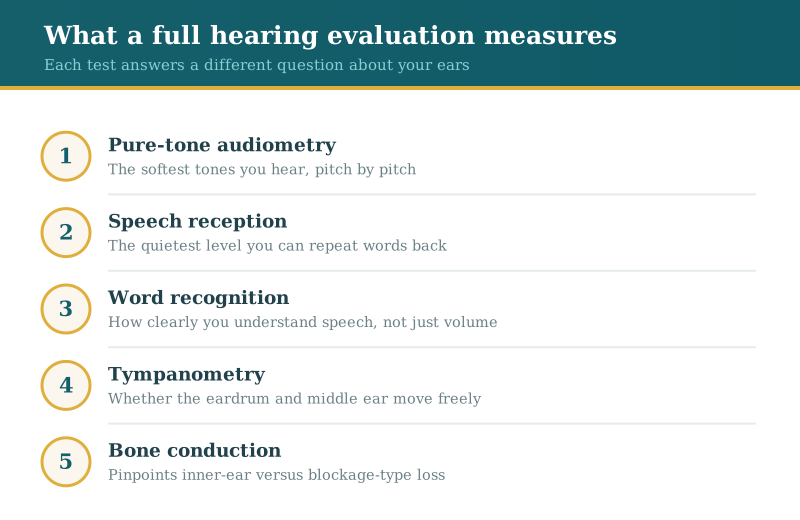
The reason for the variety is simple. Hearing can break down in more than one place — the outer or middle ear, the inner ear, or the nerve pathways beyond it — and no single measurement can tell those apart. Pure tones show the softest sounds you detect. Speech testing shows how well you make out words. Middle-ear checks show whether sound is even reaching the inner ear cleanly. Put together, they form a picture that guides everything that follows, from earwax to hearing aids.
At California Hearing Center, the full workup takes about an hour, it is comfortable, and nothing about it is invasive. Whether you have noticed a change yourself or a family member nudged you, our San Mateo and San Carlos offices can sort out what is happening and what, if anything, is worth doing about it.
At a glance
- A complete hearing evaluation combines several tests, not just the beep-and-respond one.
- Pure-tone audiometry maps the softest sounds you hear across low and high pitches.
- Speech testing measures how clearly you understand words, which tones alone cannot show.
- Middle-ear checks reveal whether the problem is blockage, fluid, or the inner ear itself.
More than raising your hand
A quick screening — the kind offered at a health fair or built into a phone app — answers one blunt question: do you pass or not? That has its uses as a first nudge, but it stops well short of a diagnosis. A full hearing test run by an audiologist measures the type, degree, and pattern of any loss, in each ear separately. Those details are what turn a vague 'I think I'm missing things' into a plan you can actually act on.
Reading an audiogram
The centerpiece of most evaluations is pure-tone audiometry. You listen for tones at different pitches, from low rumbles to high whistles, and signal the moment you first catch each one. The results are plotted on a chart called an audiogram, with pitch running left to right and loudness top to bottom. The shape of that curve tells a story: high-frequency loss, for instance, often explains why you hear that someone is talking but can't quite make out the consonants. Age-related and noise-related loss each tend to leave their own signature on the graph: age usually slopes gently downward across the highs, while noise carves its own signature at 4,000 Hz.
Testing words, not just tones
Catching a beep and following a conversation are two different skills, which is why we also test speech directly. In one part, we find the softest level at which you can repeat back simple two-syllable words. In another, we play words at a comfortable volume and score how many you get right. This word-recognition number matters a great deal for hearing aids: it hints at how much clarity you can expect to regain, not just how much louder we can make things. Someone can have a mild loss on the audiogram yet struggle more than the chart alone would predict.
Looking at the middle ear
Some hearing problems are mechanical rather than nerve-related, and separate tests catch those. Tympanometry uses a soft probe and a gentle change in air pressure to check how freely your eardrum moves — a good way to flag fluid, congestion, or a pressure imbalance behind the drum. Bone-conduction testing, using a small vibrating pad behind the ear, sends sound straight to the inner ear and bypasses the outer and middle parts entirely. Comparing the two tells us whether something as simple as earwax or fluid is the culprit, or whether the inner ear is where the change lies.
From results to a plan
Once the pieces are in, we sit down and walk through them in plain language — what your ears are doing, in which pitches, and how it lines up with the trouble you actually notice day to day. Sometimes the answer is reassuring and no treatment is needed. Sometimes it is a wax removal and a recheck. When hearing aids make sense, the same test results steer the fitting, because your audiogram becomes the prescription that shapes how any hearing aids are programmed for your ears.
When to get checked sooner
Most hearing loss creeps in over years, so an annual check is the sensible baseline once you are past 60 or work around noise. A few situations, though, warrant a same-week call rather than a scheduled visit: a sudden drop in one ear, hearing loss with dizziness or ringing, or pain and drainage. Sudden sensorineural hearing loss in particular is treated as a medical urgency, and the National Institute on Deafness and Other Communication Disorders advises seeking care right away, since prompt treatment improves the odds of recovery. If that describes you, contact our team or your doctor without waiting.
Frequently asked questions
Common questions about The Different Ways to Test for Hearing Loss
Does a hearing test hurt?
Not at all. Every part is painless and non-invasive — you listen to tones and words through headphones, and a soft probe checks eardrum movement with a light change in air pressure. There are no needles and nothing sharp, and you can stop at any point. Most people find the full evaluation relaxing more than anything.
How long does a full evaluation take?
Plan on roughly an hour for a first visit. That covers a short conversation about your history and concerns, the pure-tone and speech testing, the middle-ear checks, and time afterward to go over what the results mean. Follow-up visits are usually shorter.
Do I need a referral to get my hearing tested?
In most cases, no — you can book directly with us. Some insurance plans do ask for a referral before they will cover a visit, so it is worth a quick check with your plan. Our front desk can help you sort out coverage before you come in.
What if the test shows I have hearing loss?
Having numbers in hand is a good thing, because it turns guesswork into options. Depending on what we find, the next step might be earwax removal, a simple recheck, or a conversation about hearing aids. We explain the results clearly and never push you toward anything you are not ready for.