


Hearing & Brain Health
Researchers have noticed that people with untreated hearing loss tend to score differently on tests of attention and recall, and the pattern holds across a good number of studies. That is an association, not a verdict: it shows the two things travel together, not that one causes the other.
What this means for you is practical rather than alarming. Caring for your hearing lightens the daily mental load and keeps you in the conversations that keep your mind busy. A hearing evaluation is a straightforward place to start, and our team can walk you through what your results actually mean for you.
At a glance
- Hearing loss is linked to poorer attention and recall in daily life, though a link is not proof of cause.
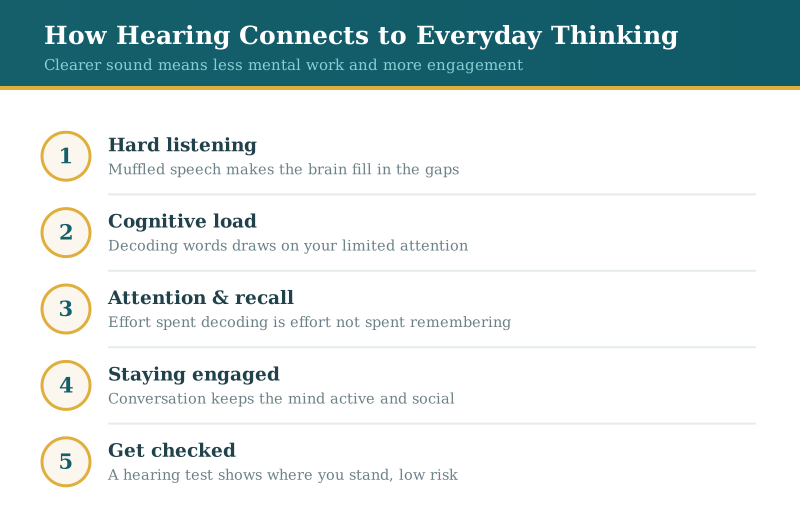
- When speech is hard to catch, the brain spends effort decoding words that could go toward following and remembering the point.
- Treating hearing eases that mental load and keeps you engaged in the conversations and activities that exercise your mind.
The hidden mental work of hard listening
When sound arrives clear, understanding speech feels effortless. When it arrives muffled, your brain fills in the gaps, guessing at words and piecing meaning together on the fly. That guesswork is genuine cognitive work, and it draws on the same attention you would rather spend on the actual conversation. By the end of a long meal or meeting, that is often why you feel worn out even though you have been sitting still.
Attention, memory, and the price of decoding
The catch is that your mind has a limited budget for any single moment. Spend a chunk of it wrestling a blurry sentence into shape, and less is left for holding onto what was said. People sometimes describe this as a memory problem when it is really a hearing problem in disguise: the words never landed clearly enough to be remembered in the first place. Making speech easier to hear, often through a well-matched hearing aid fitting, frees up that budget for following and recalling the point.
Staying in the conversation keeps the mind busy
Rich, back-and-forth conversation is one of the better daily workouts your brain gets. When hearing makes group settings feel like too much effort, it is tempting to sit them out, and that pullback tends to compound over time. Reduced engagement carries its own association with dulling cognition. Treating hearing helps in a way you feel immediately: you stay in the phone calls, the card games, and the family dinners rather than drifting to the edge of them. That benefit arrives now, not years down the line.
What treatment can and cannot promise
It would be dishonest to say hearing aids sharpen memory or hold off cognitive decline; the research does not support that leap, and no honest clinician should make it. What treatment reliably does is reduce the effort listening demands and keep you connected to the people and activities around you. Those are worthwhile gains on their own terms. Scientists are still sorting out how much treating hearing changes the longer arc of brain health, and for whom, so the case for acting rests on the everyday payoff rather than a guarantee.
A sensible first step
You do not need to settle the science to make a smart move about your ears. If conversations have started to feel like harder work, or loved ones repeat themselves more than they used to, a simple hearing test will tell you where things stand. Older adults in particular tend to notice the difference quickly, and there are options built with that stage of life in mind, from hearing aids for seniors to fittings tuned for busy, noisy days. When you are ready, you can schedule an evaluation and go from there.
More help beyond the hearing aid
Listening can be tiring when hearing is poor. Our Hearing Better hub shows skills, training and technology that make listening easier.
Frequently asked questions
What patients often want to know
Can hearing loss make me feel more forgetful?
It genuinely can, in a roundabout way. When words are hard to catch, your brain spends effort decoding them instead of storing them, so conversations do not stick the way they should. That can look and feel like forgetfulness even when memory itself is fine. Improving how well you hear often clears up a good part of it.
Does that mean treating my hearing will prevent memory problems?
That is a bigger claim than the evidence can back, and we would not make it. Hearing aids reliably ease listening and help you stay socially connected, both of which matter for daily sharpness. Whether treatment shifts the long-term picture of brain health is something researchers are still studying.
I am tired after social events but hear okay one-on-one. Should I get checked?
Yes, that pattern is worth a look. Many people manage fine in quiet, close settings and only struggle when background noise and several voices pile up. A hearing evaluation can measure exactly that kind of listening, and our team can explain what the results suggest for your everyday life.