


Choosing Hearing Aids
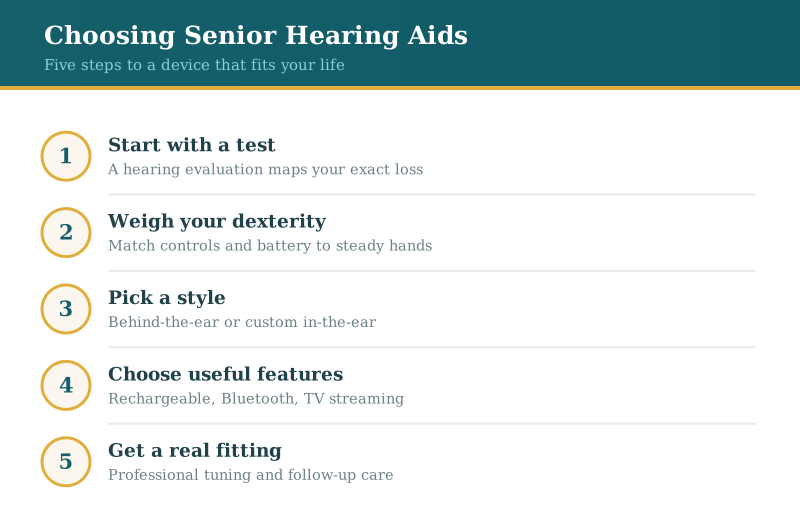
What makes a device right for a senior is rarely the feature list. It comes down to fit with daily life: steady enough hands to manage a tiny battery, eyesight for the controls, the rooms and gatherings where hearing matters most, and how much high-frequency sound has already faded. A hearing evaluation measures that last piece precisely, which is why a sensible choice starts there rather than in a catalog.
Our audiologists in San Mateo and San Carlos fit hearing aids for older adults every week, and the pattern holds: the people who do best are not the ones who bought the priciest model, but the ones whose device suited their hands, their ears, and their routine. You can read how current patients describe that experience in our reviews.
At a glance
- Modern devices are smaller, clearer, and far easier to handle than older models.
- The right style depends on dexterity, vision, lifestyle, and degree of loss — not price alone.
- A proper fitting and steady follow-up matter more than the brand on the box.
How senior hearing aids improved
Age-related hearing loss, the slow fading of higher pitches over the years, is among the most common conditions in older adults, and researchers are still working out how much it shapes thinking, mood, and connection. The technology built to treat it has moved a long way. Today's aids process sound digitally, hold down steady background noise, cancel the old whistling feedback, and shrink the electronics to a size that tucks behind or inside the ear. Many now recharge overnight in a small case, which retires the fiddly job of swapping a battery the size of a shirt button.
Matching the device to your hands and eyes
A feature that looks great on paper is useless if you cannot work it. Arthritis, reduced grip, and changing eyesight all shape which hearing aid will still be in the ear a year from now instead of a drawer. Someone who finds small objects hard to handle is usually better served by a slightly larger behind-the-ear model with a magnetic charger than by a near-invisible device with fingernail-sized controls. Bring this up plainly at the fitting; it steers the choice as much as your test results do.
Behind-the-ear or in-the-ear: which suits you
Two families cover most seniors. Behind-the-ear styles rest the main body over the ear with a thin wire or tube into the canal. They tend to be sturdier, simpler to insert, easier to handle, and roomy enough for larger controls and stronger batteries — a common fit for age-related loss. Custom in-the-ear styles sit entirely in the ear with nothing showing above it, which many people prefer for looks and for wearing glasses comfortably, though the smaller shell can be harder to grip and holds a smaller battery. Neither is better across the board; the honest answer comes from your hearing level, your dexterity, and which trade-off you would rather live with. We fit both across a range of brands.
Features that earn their keep
Skip the marketing and look at what changes an ordinary day. Rechargeable batteries help anyone tired of pill-sized cells and stiff clasps. Bluetooth streaming sends phone calls, television, and music straight into the aids, which often solves the too-loud TV standoff at home. A telecoil connects to loop systems in many theaters and places of worship. And several models let an audiologist fine-tune settings remotely, so a small adjustment need not always mean a drive to the office. Choose the two or three features that match how you actually spend your time, and let the rest go.
The fitting is where it comes together
A hearing aid out of the box is not tuned to your ears. The fitting is where an audiologist programs it to your specific hearing test, verifies that the right sounds reach you at the right levels, and teaches you to insert, clean, and charge it. Expect a follow-up or two in the first months, because the brain needs time to relearn sounds it has been missing and the settings usually want a nudge. Keep in mind that these are small electronics worn in a warm, waxy environment; occasional repair and routine cleaning are part of ownership, not a sign anything went wrong.
Frequently asked questions
Questions patients ask us
Which hearing aid is best for an older adult?
The best device is the one matched to your hearing test, your dexterity, and the situations you most want to hear in. A retiree who mainly wants quiet dinners to feel easier has different needs than someone still working in meetings. Start with a hearing evaluation and let the results, not an advertisement, narrow the field.
Are rechargeable hearing aids a good idea for seniors?
For anyone who wrestles with tiny batteries or stiff fingers, they usually are. You set the aids in a case at night and lift them out charged in the morning, with no small cells to buy or fumble. The trade-off is that you cannot swap in a spare battery mid-day, so people who travel far from an outlet sometimes still prefer the traditional kind.
Will insurance help with the cost?
It depends on your plan, and it is worth checking before you shop. Some Medicare Advantage and private plans include a hearing aid benefit, while others cover the evaluation but not the devices. Our team can review your coverage with you; see our insurance page for what to ask and what to bring.
My father won't even discuss hearing aids. What helps?
Pressure rarely moves anyone; a low-stakes hearing test often does. Framing it as a simple check rather than a commitment lowers the wall, and families are frequently surprised by how much clearer a good result makes the case. Our team is used to first-timers and explains options without any hard sell.