


Family & Connection
It isn't your imagination, and it isn't distraction. Higher-pitched sounds are usually the first to fade with age-related hearing loss, and children's voices sit right in that range. So do many women's voices, which is part of why a grandchild's breathless retelling of their day can be the hardest speech of all to catch. A simple hearing evaluation can show whether that pattern matches what's happening with your ears.
This is also one of the more fixable communication problems we see. Today's hearing aids are designed to lift those high, soft sounds back into range, and for many grandparents that means catching the punchline of a knock-knock joke the first time around instead of the third.
At a glance
- High-frequency hearing loss takes children's and higher voices first, so grandchildren are often the hardest family members to hear.
- Turning up the TV doesn't help much, because the trouble is clarity of high, soft sounds rather than overall volume.
- A hearing evaluation, and well-fit hearing aids if you need them, can bring those voices back within reach.
The voices you miss most
Pay attention to when the trouble shows up. Adult conversation in a calm room may feel fine, while a five-year-old's chatter from the next seat blurs into noise. The difference is pitch. Consonant sounds like s, f, th, and k carry much of the meaning in speech, they sit high in the frequency range, and they are quiet to begin with. Children pack their sentences with these sounds and deliver them fast, so when your high-frequency hearing dips, their words are the first to come apart.
Why a grandchild's voice fades first
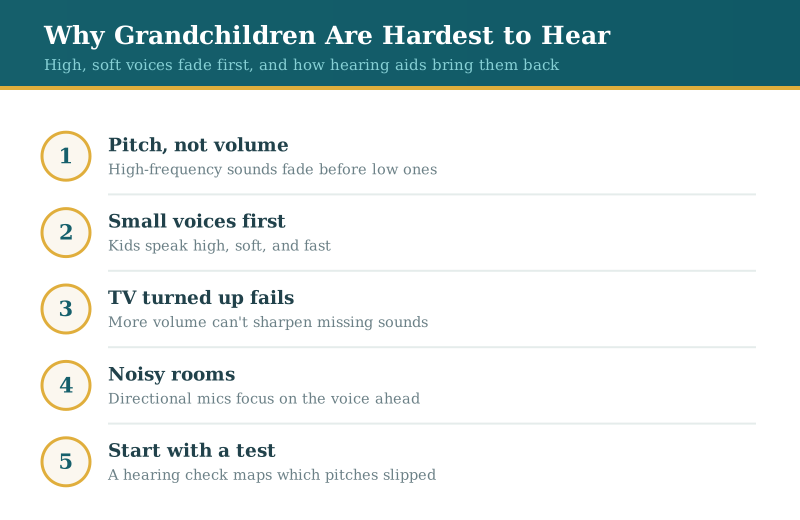
Age-related hearing loss typically begins in the high frequencies and works its way down, which is why the change can feel selective rather than like a uniform drop in volume. You hear that something was said; you just can't make out what. That high-frequency pattern is the usual shape of age-related hearing loss, as the federal NIDCD describes it. It also explains why turning up the television rarely solves anything — more volume on the sounds you already hear doesn't sharpen the ones you're missing.
Holidays, car rides, and the kids' table
Family settings stack the deck against you. Birthday parties, holiday dinners, and restaurants all mix competing voices, clattering dishes, and hard surfaces that bounce sound around. Add a grandchild's high, quick voice on top of that and even good ears work overtime. Where you sit helps — put the youngest talkers on your better-hearing side and keep your back to a wall — but positioning only goes so far. Modern hearing aids are built for these rooms, using directional microphones that favor the person in front of you and soften the din around the edges.
Two styles worth weighing
For grandparents focused on family time, two hearing aid styles come up most often. Receiver-in-canal models sit behind the ear with a thin wire running into the canal; they're discreet, comfortable through a long gathering, and handle a wide range of hearing loss, which makes them a frequent first choice. Custom in-the-ear models sit entirely inside the ear and can be easier to manage if handling tiny parts is hard on arthritic fingers, though the smallest versions leave less room for the strongest noise-handling features. Neither is simply the better one. The right pick depends on your hearing test, your dexterity, and how much time you spend in loud rooms, and a hearing aid fitting is where those trade-offs get sorted out. It helps to compare options across brands too, since sizes and features vary.
Getting back into the conversation
If catching your grandchildren has gotten harder, the next step is a small one. A hearing evaluation maps exactly which pitches have slipped, and from there we can talk through whether hearing aids for seniors make sense for how you actually spend your days. Our team fits a lot of grandparents, and the aim is plain: fewer 'what did you say, sweetheart?' moments and more of the real conversation. When you're ready, you can reach the office to set up a visit.
Frequently asked questions
Your questions, answered
Why can I hear my adult children but not my grandchildren?
It comes down to pitch. Grown voices carry more low-frequency energy that stays audible longer, while children speak higher and softer, right in the range that age-related hearing loss affects first. That's why it can feel easier to follow an adult across the room than a grandchild sitting beside you. A hearing test can confirm whether that high-frequency pattern is what's going on.
Will hearing aids actually help with kids' voices specifically?
That's exactly the situation they're built for. Hearing aids can be tuned to boost the high frequencies where children's speech lives, so those sounds come through clearly without making everything else uncomfortably loud. Many grandparents notice the difference most at the dinner table and in the car, where small voices used to disappear.
My gatherings get loud — can a hearing aid keep up?
Loud family rooms are one of the tougher tests, but current technology handles them far better than older models did. Directional microphones focus on the voice in front of you while easing the background clatter. During a fitting, we can set up specific programs for noisy settings so a birthday party feels less like a wall of sound.
How do I start without making it a big deal?
Begin with a straightforward hearing check — no commitment beyond finding out where things stand. The evaluation is comfortable and takes about an hour, and you'll leave knowing which pitches have changed and what your choices are. If it would help, our team can walk a family member through the results as well.