


Hearing Aid Technology
The word 'AI' gets stretched thin in advertising, so it pays to be specific about what is new. What genuinely changed is that some aids now carry a small deep-learning model, trained ahead of time on huge amounts of everyday sound, that sorts speech from noise as you go. It is a real advance, not a miracle, and the difference between those two framings is the whole point of this post.
None of it replaces a careful setup for your ears. If you are curious whether it would help you, the practical next step is an evaluation and a conversation at our San Mateo or San Carlos office, where you can hear what the processing does rather than read about it.
At a glance
- AI hearing aids run a deep-learning model that separates speech from background noise in real time.
- The processing happens on the device itself, so no phone or internet connection is needed for it to work.
- It sharpens speech in noise and eases listening effort, but it does not restore normal hearing or replace a proper fitting.
From turning everything up to sorting sound
For decades a hearing aid mostly made incoming sound louder and shaped it to match your hearing loss. Newer processing goes further. Instead of amplifying a room wholesale, the device tries to identify what it is hearing — a voice, a fan, dishes, wind — and handle each differently. That sorting step is the core of what companies label AI, and it is why a modern aid can hold onto a conversation while easing the din behind it. If you last wore hearing aids ten years ago, this is the part that will feel new.
How the model tells voices from noise
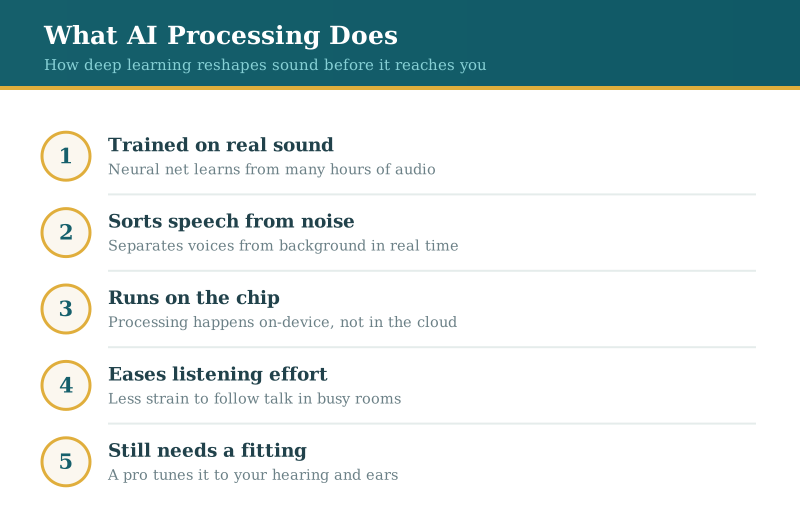
The engine behind it is a deep neural network, trained beforehand on many hours of recorded sound until it learns the acoustic fingerprint of speech against everything else. That trained model is loaded onto a tiny chip inside the aid, where it runs continuously and readjusts within milliseconds as your surroundings shift. Difficulty following speech in noisy places is one of the most common frustrations people bring to us, and this is the technology aimed squarely at it. The aid is not understanding words the way you do; it is making very fast statistical guesses about which sounds to lift and which to soften.
Where the limits are
A measured look matters here, because the marketing rarely offers one. AI processing can make a hard listening environment noticeably easier, yet it does not hand back the hearing you had at twenty, and it cannot rescue a poorly matched device. If the aid is not tuned to your specific loss, no algorithm closes that gap. It also has limits in genuinely chaotic rooms, and it works best alongside plain habits like facing the person you are speaking with. Treat it as a strong tool, not a cure.
Fitting the technology to your hearing
The smartest processing in the world still has to be set up for your ears. That begins with a hearing test to map where your hearing has changed, followed by a careful fitting that tunes the device, AI features included, to those results. We fit models across the major brands, so the aim is matching the technology to your life rather than selling one label. For many older adults weighing hearing aids for the first time, these features are less a gimmick than the reason today's devices are worth a fresh look. Our audiology team can show you what the processing does in a real conversation, not just on a spec sheet.
Frequently asked questions
How AI Is Changing Hearing Aids: questions we hear a lot
Do AI hearing aids really help in noisy restaurants?
In many cases, yes, since that setting is exactly what they are built for. By separating voices from the clatter around them, they can make a busy table markedly easier to follow. The effect varies with the room and the severity of your loss, so trying them in your own environments is the honest way to judge.
Is 'AI' here just a fancy word for Bluetooth?
No, the two are separate features. Bluetooth streams audio from your phone or TV into the aids. The AI is the on-board processing that decides how to handle the sound already reaching the microphones. A device can offer one, both, or neither, which is worth sorting out before you compare models.
Do I have to use an app for the noise processing to work?
Usually not. The core processing runs automatically on the chip inside the aid, whether or not your phone is nearby. Companion apps mostly let you fine-tune or override what the device is already doing, so the AI keeps working even if you never open one.
Does the hearing aid send my conversations to the cloud?
For the noise processing, no. The trained model lives on the device and runs locally, so your surroundings are analyzed on the aid itself rather than uploaded anywhere. If you have privacy questions about a particular brand's app features, we are happy to walk through them with you.
Are these worth the higher price?
It depends on where and how you struggle to hear. Someone who mainly wants help in quiet rooms may not need the top tier, while someone who battles restaurants and meetings often finds the processing pays off. We would rather match you to the right level than push the most expensive option.
How do I tell if an AI hearing aid suits me?
Start with an evaluation of your hearing and a frank talk about your daily listening. From there we can say whether the advanced processing is likely to help you in particular. You can reach our offices to set up a visit and try the technology before you commit to anything.