


Hearing Aids & Styles
"Invisible" usually refers to two custom styles, IIC (invisible-in-canal) and CIC (completely-in-canal), plus deep-fit, extended-wear options like Lyric that a professional places well down inside the canal. All of them trade some size for some capability, and none suit every ear or every degree of hearing loss.
What makes a hearing aid nearly invisible, who tends to do well with one, and whether your ears are a good fit all come down to a proper hearing evaluation and ear exam.
At a glance
- Invisible styles (IIC, CIC) and deep-fit devices like Lyric hide inside the ear canal.
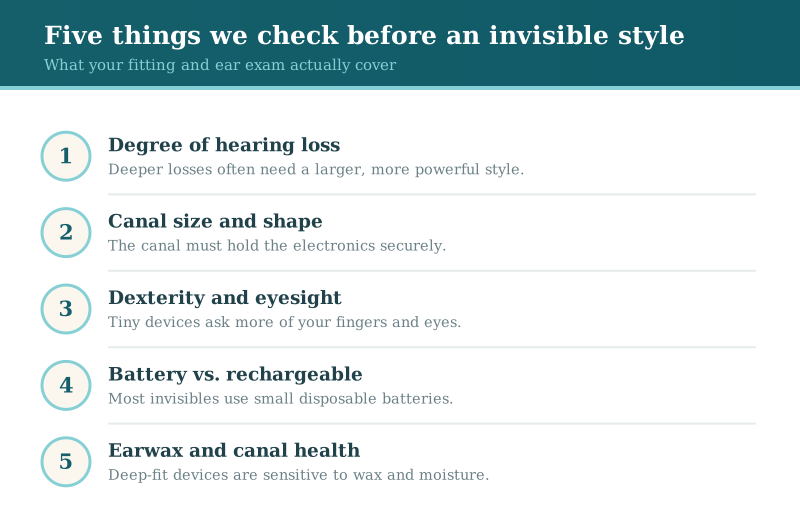
- Candidacy depends on canal size and shape, dexterity, and degree of hearing loss.
- Smaller size means smaller batteries and fewer features than larger styles.
- A fitting and ear exam, rather than a photo, determine what will actually work for you.
What counts as invisible
The two most discreet custom styles are IIC (invisible-in-canal) and CIC (completely-in-canal). Both are molded to your ear and sit deep enough that they are hard to spot in normal conversation. The removal cord on the faceplate is what settles how far one is meant to go in: deep enough to disappear, never deeper than you can pinch the cord and lift it out. Extended-wear devices like Lyric go a step further: a clinician places them deep in the canal, and you wear them continuously for weeks or months at a time. All of these differ from the more common behind-the-ear styles you can browse among hearing aid brands.
Who tends to be a good candidate
Invisible aids fit best for adults with mild to moderate, or moderately severe, high-frequency hearing loss, the most common pattern. They also work best when your ear canals are roomy enough to hold the electronics and shaped in a way that keeps the device secure. If that describes you, a nearly invisible fit is often realistic.
Who they may not suit
Deeper losses usually need more power and a larger receiver than a tiny shell can hold, so a bigger style often performs better. Very small or sharply curved canals can be hard to fit. And because these devices are little, they ask more of your fingers and eyesight, since handling a battery the size of a lentil is not for everyone. Sorting out which of these apply to you is exactly what a hearing aid fitting is for.
Battery vs. rechargeable trade-offs
Most truly invisible customs use tiny disposable batteries, since a rechargeable cell and its charging coil take up room these shells do not have. Larger in-the-ear and behind-the-ear styles more often offer rechargeability. Extended-wear devices work differently again: you do not touch the battery at all, because the clinician replaces the whole device on a schedule. Which trade-off suits you depends on your hands, your habits, and your patience with small parts.
Features you may give up for the size
Shrinking a hearing aid means leaving things out. Many invisible models have limited or no direct Bluetooth streaming, fewer microphones for tricky noisy rooms, and no external buttons, so adjustments happen through your app or your audiologist. If phone streaming or the strongest noise handling matters most to you, a slightly larger style may serve you better.
Why canal and ear health matter
Because these devices live deep in the canal, they are more sensitive to wax and moisture than styles that sit outside. Excess earwax can muffle sound, cause feedback, or block the device entirely, so keeping the canal clear matters, sometimes with professional earwax removal rather than cotton swabs. A healthy, unobstructed canal is part of what makes an invisible fit work day to day.
How we decide what is realistic
There is no way to know from the outside whether an invisible aid will suit you. We start with a full hearing test, look inside your ears, measure your canals, and talk through your dexterity, your priorities, and your budget. Sometimes the answer is a beautiful invisible fit; sometimes a slightly more visible style will simply hear better for your loss. Either way, you leave knowing why.
Frequently asked questions
Questions patients ask us
Are invisible hearing aids as good as bigger ones?
For the right hearing loss, they perform very well. But smaller shells hold smaller batteries and fewer features, so for deeper losses or heavy phone streaming a slightly larger style may hear better. The best choice depends on your ears and your priorities.
Can anyone wear invisible hearing aids?
No. Candidacy depends on your degree of hearing loss, the size and shape of your ear canals, and how comfortable you are handling tiny devices. A fitting and ear exam tell you whether an invisible style is realistic for you.
Do invisible hearing aids need special care?
They benefit from it. Because they sit deep in the canal, wax and moisture affect them more, so routine cleaning and occasional professional earwax removal help them keep working reliably.
What is an extended-wear hearing aid like Lyric?
It is a small device a clinician places deep in your canal, worn continuously for weeks at a time before being replaced. You never change a battery, but candidacy still depends on your canal anatomy and hearing loss, which we check first.