


Invisible Hearing Aids
These are custom devices. An impression of your ear canal is taken, and the shell is built to your own anatomy so it seats deeply and comfortably. Because the electronics ride further in than they do on a behind-the-ear model, the outer ear stays uncovered and the device is hard to spot from across a table. Getting that fit right is the whole job, which is why a careful hearing aid fitting matters as much as the hardware.
Invisible is not automatically the right pick for everyone, and that is worth saying plainly. Whether the style suits you comes down to your hearing, your ear canal, and how you use your hands day to day. The honest first step is a hearing evaluation, which tells us how much amplification you need before anyone talks about styles.
At a glance
- Invisible styles like the Oticon Zeal line sit deep in the ear canal and are hard to spot in normal conversation.
- They suit some hearing losses and ear canals better than others, so candidacy is individual.
- Going smaller trades some battery size and features for the discretion.
- An in-person evaluation and fitting is the only reliable way to know if they fit you.
Where these devices sit
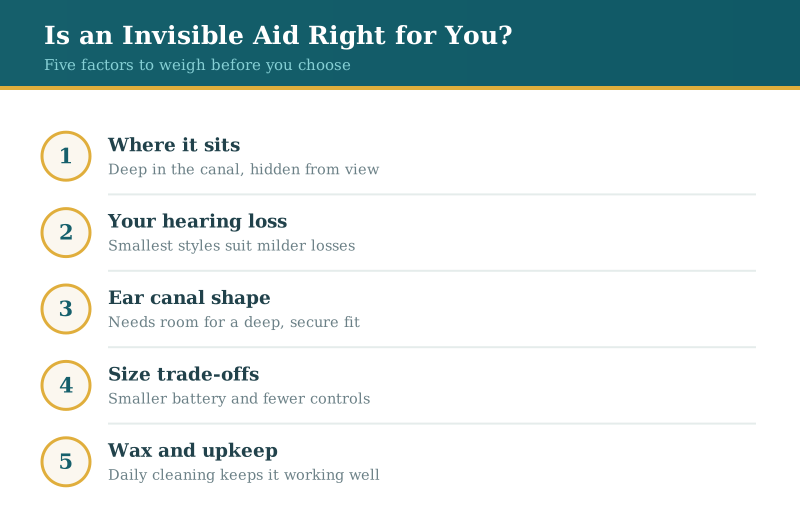
Invisible-style aids are built to rest deep in the ear canal rather than in the bowl of the outer ear or behind it. The shell is molded to your canal, so it disappears from the ordinary sightlines of a conversation. This deep placement also puts the microphone closer to the eardrum, which some wearers find gives a natural sense of sound and helps a little on the phone. The catch is that everything has to fit inside a small space, and not every ear has room for it.
How your hearing loss factors in
The amount of amplification you need is the first thing that decides whether an invisible aid makes sense. As a general rule, the smallest in-canal styles suit mild to moderate hearing loss; stronger losses often call for a larger device that can deliver more power without feedback. This is not a judgment of style over substance, it is physics: a tiny speaker in a tiny shell can only do so much. Your audiogram from a hearing test is what settles the question, not a preference stated in advance.
Ear canal shape and comfort
The size and bend of your ear canal matter just as much as your hearing numbers. A deep-fitting device needs enough room to seat securely without pressing uncomfortably, and some canals are simply too narrow or too curved for the smallest styles. You place and remove these yourself, so the shell can only sit as deep as your fingertips can still reach the removal cord, which is the practical test for a device you can still take out yourself. During a fitting we look at this directly and take an impression. If an invisible aid will not sit well, we would rather tell you up front than have you fight a device that never feels right.
The trade-offs of going small
Discretion comes at a price, and it helps to know it going in. A smaller shell holds a smaller battery, so it may need charging or a fresh cell more often than a larger model. There is less room for manual controls and for some of the wireless features that bigger aids offer, though many invisible models still pair with a phone. Handling a tiny device also asks a bit more of your fingertips. None of this rules the style out; it just means the choice is a genuine balance, not a free upgrade.
Earwax and daily upkeep
Sitting deep in the canal puts these aids right where earwax and moisture collect, so upkeep is part of the deal. A quick daily wipe and keeping the device dry go a long way, and the wax guards are meant to be changed on a schedule. If your ears run waxy, periodic earwax removal in the office keeps both your hearing and the device working as they should. We show you the routine at the fitting so none of it is a guess.
Finding out if they fit you
The only way to know whether an invisible aid is right is to be evaluated and fitted in person. That starts with a hearing test, moves to an honest talk about your ears and your daily habits, and ends with an impression if the style suits you. From our San Mateo and San Carlos offices we fine-tune the settings and check the fit over follow-up visits, because the first day is rarely the last adjustment. When you are ready, you can schedule a visit and we will walk you through the options without any pressure.
Frequently asked questions
Your questions, answered
Are invisible hearing aids truly invisible?
For most wearers they come very close. Because the device sits well inside the canal, people you talk with face to face rarely spot it, though someone peering straight into your ear from up close might catch the faceplate. How hidden it ends up depends partly on the size and shape of your own canal, which is one more reason the fitting matters.
Can anyone choose the invisible style?
Two things mostly decide it: how much amplification your hearing calls for and whether your ear canal has room for a deep-fitting shell. Milder losses and average-to-roomy canals are the easiest match. We check both during an evaluation and will tell you honestly if a slightly larger style would serve you better.
Does a smaller aid mean weaker sound?
Sound quality depends far more on programming than on size. A well-adjusted invisible aid can sound excellent for the losses it is designed to cover, while a poorly set device of any size will disappoint. That is why the fitting and follow-up tuning do more for how you hear than the label on the box.