


Hearing Aid Technology
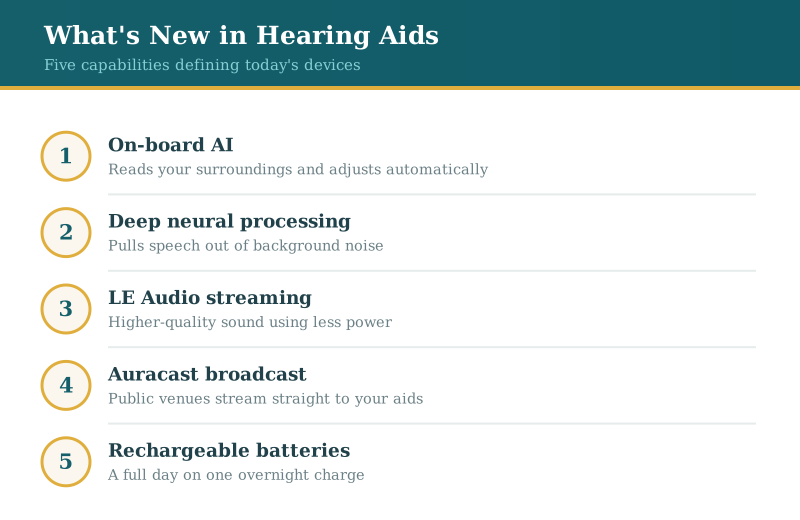
Three shifts stand out. Chips inside the newest aids can run neural-network sound processing on board, separating speech from background noise more cleverly than fixed rules ever could. A wireless standard called LE Audio, along with a broadcast feature named Auracast, is changing how aids connect to phones, televisions, and public sound systems. And rechargeable batteries have matured to the point that many wearers never handle a tiny disposable cell again.
None of this replaces a careful fit. The smartest chip in the world still needs to be programmed to your ears and your listening life, which is what a professional fitting is for. Our San Mateo and San Carlos team fits current technology across most major brands, so we can explain what these features mean in plain terms and which ones you'll truly use.
At a glance
- The newest hearing aids use on-board AI and deep neural networks to separate speech from noise more effectively.
- LE Audio and Auracast are new wireless standards that improve streaming and let aids tap into public broadcast sound.
- Rechargeable batteries and direct phone connectivity are now standard on many current models.
Chips that learn what you're listening to
Older hearing aids followed fixed rules: detect loud low-frequency sound, assume it's noise, turn it down. The current generation leans on artificial intelligence instead. Onboard processors are trained ahead of time on enormous libraries of real-world sound, so the aid can recognize the kind of place you're in — a quiet kitchen, a busy restaurant, a moving car — and shift its settings on its own. You don't push buttons; the device reads the room. That scene-detection ability is one of the clearest dividing lines between older stock and today's flagship models.
Separating a voice from the racket
The feature people notice most is speech clarity in a crowd. Newer chips run what engineers call a deep neural network, software modeled loosely on how the brain handles patterns and trained specifically to pull a talking voice out of competing sound. Rather than simply lowering the background and dulling everything, the aid works to keep the voice you're following crisp while pushing the clatter behind it back. For anyone who has struggled at a family dinner or a café, that difference matters more than any spec sheet, and it is a big reason hearing aids for seniors have become more comfortable to wear all day.
A new kind of wireless: LE Audio and Auracast
For years, hearing aids streamed audio through workarounds that drained batteries and often locked you into one phone brand. LE Audio changes the plumbing underneath: it moves higher-quality sound using less power and supports both major phone platforms more evenly. Bundled with it is Auracast, a broadcast feature that lets one source send audio to many listeners at once. Picture an airport gate, a theater, or a house of worship transmitting straight to your aids the way a radio station reaches many radios. The rollout is gradual and venues are still catching up, but the direction is set.
Rechargeable, connected, and easier to live with
Two more changes get less attention but touch daily life. Lithium-ion rechargeable batteries now last a full day on a charge for most wearers, which ends the fiddly ritual of swapping a cell the size of a lentil, a genuine relief for anyone with dexterity or vision trouble. A direct link to your phone lets you take calls, stream music, and fine-tune settings from an app, and some models add extras like fall detection or step counting. If any of this sounds appealing, the place to start is not a store shelf but a hearing evaluation that shows what your ears actually need.
Frequently asked questions
Questions patients ask us
Do I need the newest technology to hear better?
Not necessarily. A well-matched aid from a recent generation can serve you beautifully, and the right choice depends on your hearing, your budget, and where you spend your day. The latest features earn their keep most if you're often in noisy places or you stream a lot of audio. We'll help you weigh what's worth paying for.
What does 'AI' really mean in a hearing aid?
It refers to sound processing that was trained in advance on huge collections of real-world audio, so the device can classify your surroundings and respond without you touching a control. It isn't a chatbot living in your ear. Think of it as a smarter, more flexible autopilot for sound.
Is Auracast available where I go?
Coverage is still growing. Some airports, theaters, and public buildings have begun installing it, but you shouldn't buy an aid today expecting Auracast everywhere tomorrow. Treat it as a useful bonus that will matter more over the next few years, not something you'll lean on this week.
Are rechargeable aids better than battery ones?
For many people, yes: no tiny cells to change, and a case that tops up overnight. If you travel where charging is unreliable, or you wear your aids around the clock, traditional batteries still have a place. It comes down to your routine, which we can talk through at a fitting.
Will newer aids work with my iPhone or Android?
Most current models connect directly to both, though the depth of features can vary by platform and maker. Bring your phone to your appointment and we'll confirm compatibility before you commit. If you ever run into trouble later, our repair and support service can help sort it out.
How do I figure out which features are worth it?
Start by describing your typical week: the rooms, the people, the background noise. That paints a clearer picture than any brochure. Our team fits current technology every day and can match the capabilities to your real listening life rather than to a feature list.