


Choosing Hearing Aids
The honest answer to 'what level of loss needs treatment' is that the number on the page is only half the story. Two people can walk out with nearly identical results and have very different needs, because a teacher, a grandparent on the phone with grandchildren, and someone who spends most days in quiet rooms all live with the same loss differently. That is why the decision about hearing aids turns as much on your life as on your audiogram.
If you are trying to figure out whether it is time, the clearest next step is an evaluation at our San Mateo or San Carlos office, where we measure your hearing and, just as important, talk through how it is shaping your days.
The myth of a magic number
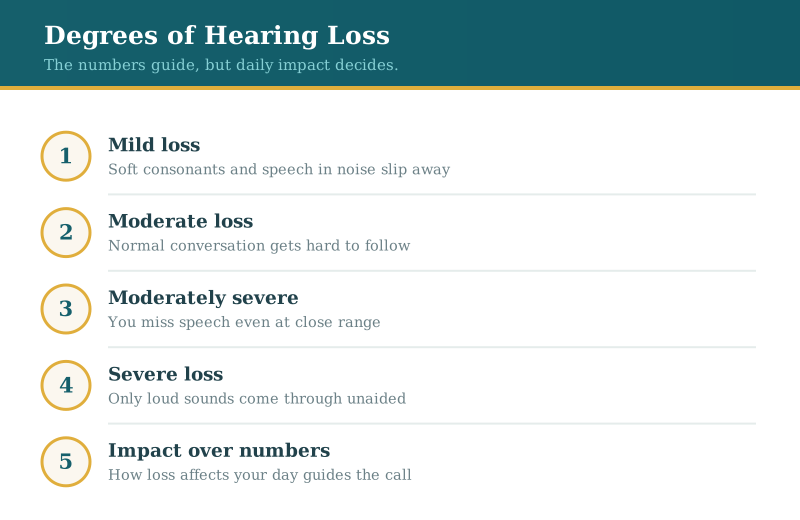
It is easy to picture hearing loss as a needle that eventually crosses a red line, after which aids become mandatory. Audiologists do sort results into ranges, using the familiar labels of mild, moderate, moderately severe, severe, and profound, but those categories mark points along a spectrum, not an on-off switch. A hearing test tells you where you land on that spectrum. It does not, on its own, announce the morning you should start wearing devices.
'Mild' loss is easy to underrate
The label 'mild' can be misleading, because it sounds like a problem too small to bother with. In practice, even mild loss tends to blur the softer consonants that carry meaning — the s, f, and th sounds — and it makes following a conversation in a busy restaurant genuinely tiring. Plenty of people benefit from hearing aids while their loss is still classified as mild, precisely because addressing it early keeps ordinary conversation from turning into daily effort.
The audiogram is a starting point, not a verdict
Here is where the numbers-only view falls apart. The chart measures the softest sounds you can detect at each pitch, which is useful, but it says little about how well you separate speech from background noise or how much strain you feel by evening. Someone with a modest-looking result who struggles constantly in meetings may have a stronger case for treatment than someone with a steeper chart who spends their days in quiet. The audiogram opens the conversation. It does not close it.
Impact is the real threshold
If a single test result will not tell you when to act, what will? Your own experience. When you find yourself asking people to repeat themselves, nudging the television louder than others prefer, dreading group dinners, or missing half of a phone call, those are the signals that the loss has begun to cost you something. That cost — not a decibel figure — is the honest measure of when hearing aids are worth it, and it is what we weigh together during a fitting consultation.
Waiting for it to get 'bad enough' works against you
Another version of the number myth says to hold off until the loss is severe and undeniable. The trouble is that hearing usually fades gradually, so 'bad enough' keeps quietly moving out of reach as you adjust to each new normal. The brain also grows less practiced at making sense of sounds it has not heard clearly in years, which can make adaptation slower the longer you wait. Acting while the loss is more moderate tends to make the transition smoother, something we see often in our work with hearing aids for older adults.
One ear, two ears, and the whole picture
A last misconception is that one 'good' ear buys you time, so a lopsided result means you can wait. Hearing works as a pair, though; your brain uses both ears to locate sounds and pull a voice out of noise, so an imbalance affects far more than raw volume. Word-recognition scores, the shape of the loss across pitches, and how your two ears compare all feed the recommendation. Sorting through that is exactly what our audiology team is there to do.
Frequently asked questions
Questions patients ask us
Is there a specific decibel level where I need hearing aids?
Not really, though many people expect one. Audiologists use decibel ranges to describe how much loss you have, but the decision to treat rests on how that loss affects your listening, not on hitting a set number. Some people benefit in the mild range while others wait longer, depending on their daily demands.
Can hearing aids help with mild hearing loss?
Yes, and this surprises people who assume aids are only for advanced loss. Mild loss often takes the crispness out of speech and makes noisy settings hard, both of which modern devices can ease. Whether it is worth it comes down to how much the loss is affecting your conversations and comfort.
How do I know if my hearing loss is bad enough to treat?
Watch your daily life rather than a single test result. Frequent requests to repeat, a creeping-up TV volume, avoiding gatherings, or leaning hard into phone calls all suggest the loss is costing you. A hearing evaluation puts those experiences alongside the measurements so the picture is complete.
Do I need two hearing aids or just one?
It depends on your results, but two is common even when one ear tests better. Your brain relies on both ears to judge direction and follow speech in noise, so treating only one side often leaves those tasks harder than they need to be. We talk through what your specific pattern of loss calls for during the consultation.