


Hearing & Your Health
The relationship is an association rather than a proven cause, and no clinician can tell you exactly how much your own hearing is affected. Secondhand smoke appears to matter too, which means the people around a smoker share some of the exposure. The Centers for Disease Control and Prevention lists smoking among the risk factors tied to hearing loss, so it is worth taking seriously even while the science keeps filling in the details.
If you smoke now, have quit, or live with someone who does, a hearing evaluation at our San Mateo or San Carlos office is a calm way to see where your hearing stands and to catch changes early.
At a glance
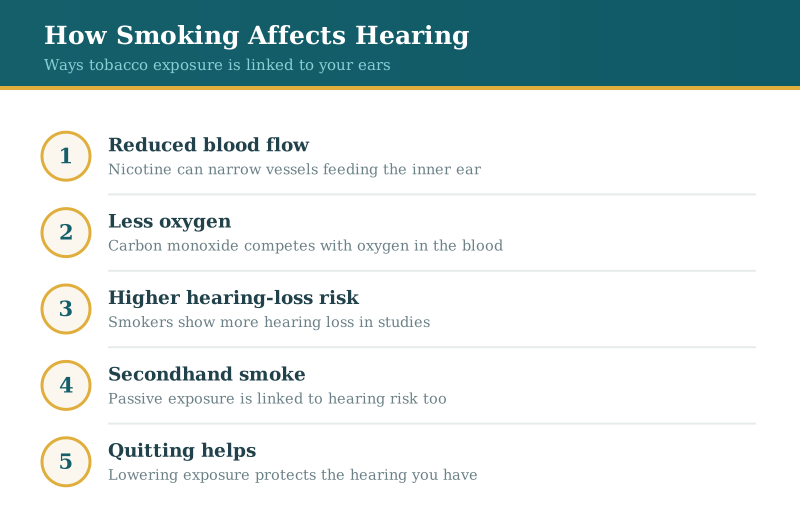
- Smokers show higher rates of hearing loss than non-smokers in research.
- Nicotine and carbon monoxide may reduce blood flow and oxygen to the inner ear.
- Secondhand smoke is also linked to hearing risk, including in children.
- Quitting lowers exposure, and a hearing test tracks how your ears are doing.
How smoking may reach the inner ear
The inner ear depends on a steady supply of oxygen-rich blood to keep its tiny hair cells working. Nicotine narrows blood vessels, and carbon monoxide from smoke competes with oxygen in the bloodstream. Researchers think this combination may leave the cochlea with less of what it needs, and those hair cells do not grow back once they are damaged. This is one plausible route rather than a settled mechanism, but it lines up with what we see: smoking tends to travel alongside poorer hearing.
What the research suggests
Large studies have repeatedly found that people who smoke are more likely to have hearing loss than people who never have, and that heavier or longer smoking often tracks with greater risk. The Centers for Disease Control and Prevention counts tobacco use among the factors associated with hearing loss. None of this proves smoking is the sole culprit for any one person, since noise, age, and genetics also shape hearing. Still, the pattern is consistent enough that it belongs on the list of reasons to quit.
Secondhand smoke and the people nearby
The exposure is not limited to the person holding the cigarette. Secondhand smoke has been linked to hearing risk in family members, and studies of children raised around smoke have raised particular concern about their ear health and middle-ear infections. If there is a smoker in the household, it is reasonable to have everyone's hearing checked, children included. Our team can test gently and explain the results without alarm.
The tinnitus connection
Smoking has also been associated with a greater likelihood of tinnitus, the ringing or buzzing many people notice in quiet moments. The same effects on blood flow may play a part, and nicotine is a stimulant that can make ringing feel more intrusive. We cannot promise that quitting will silence tinnitus, but reducing exposure is a sensible step, and our clinicians can talk through management options if the sound is wearing on you.
Quitting helps, whenever you do it
Here is the encouraging part. Cutting down or stopping lowers the exposure that may be working against your ears, and it is worth doing at any age. Quitting will not reverse hearing loss that has already set in, and we will not suggest otherwise, but it removes an ongoing risk and supports the rest of your health at the same time. If you already wear hearing aids or are considering them, protecting the hearing you have left makes that investment go further.
Getting your hearing checked
You do not need symptoms to justify a hearing test, and you certainly do not need to have quit first. A hearing evaluation is quick, comfortable, and gives you a clear baseline to measure against over the years. If the results point to loss, we will walk you through what they mean and, where it helps, discuss a hearing aid fitting suited to your life. Reach out to schedule a visit at either Peninsula office whenever you are ready.
Hearing and your wider health
See how hearing connects to other conditions on our Hearing and Your Health page.
Frequently asked questions
What patients often want to know
Can smoking really cause hearing loss?
Research consistently links smoking to a higher risk of hearing loss, but a link is not the same as proof of cause for any one person. Noise, age, and genetics matter too. Even so, smoking is a risk you can act on, which is why quitting and a hearing test both make sense.
Does secondhand smoke affect hearing?
It appears to. Secondhand smoke has been associated with hearing risk in family members, and there is particular concern for children raised around smoke and their ear health. If someone in your home smokes, having everyone's hearing checked is a reasonable precaution.
If I quit, will my hearing come back?
Quitting will not restore hearing that is already gone, since inner-ear damage does not reverse. What it does is remove an ongoing risk to the hearing you still have, at any age. Pairing that with regular hearing checks is the most practical approach.
Is smoking connected to tinnitus?
Studies have linked smoking with a higher likelihood of tinnitus, and nicotine as a stimulant can make ringing feel more noticeable. Quitting is a sensible step, and our clinicians can discuss ways to manage the sound if it is bothering you.