


Hearing & Overall Health
As with many health links, the relationship is one of association rather than a simple cause and effect. Kidney disease does not flip a switch that turns off your hearing. Instead, the two organs share biology and share risks, so trouble in one region can show up alongside trouble in the other. That gives you a practical reason to keep your ears on the radar, not a reason to worry.
A hearing evaluation is a straightforward way to do exactly that. At our San Mateo and San Carlos offices we look at the whole picture of a person's health, not just an audiogram, and we are glad to coordinate with the other clinicians on your team.
At a glance
- Chronic kidney disease is associated with higher rates of hearing loss, though association is not proof of cause.
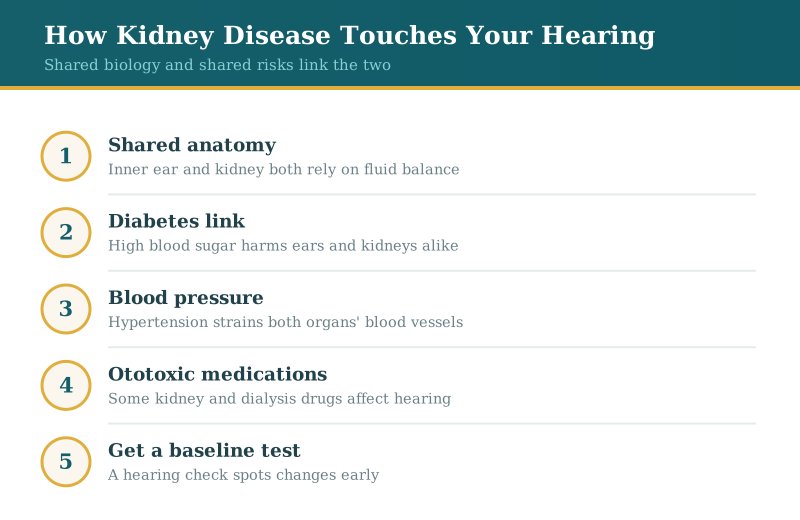
- The inner ear and kidney share anatomy and risk factors, and diabetes, high blood pressure, and certain medications affect both.
- A baseline hearing test makes future changes easier to catch and is a sensible addition to routine kidney care.
Two organs that work more alike than they look
The inner ear and the kidney seem to have little in common until you look closely. Both depend on carefully balanced fluid and mineral levels to do their jobs, and some of the same proteins appear in the tissues of each. When a condition disrupts that balance in the kidneys, the thinking goes, the fine structures of the inner ear may feel the effects too. This does not mean kidney disease directly damages hearing in every person. It means the two systems have enough in common that difficulty in one can travel alongside difficulty in the other.
The risk factors they share
Part of the connection has less to do with the organs themselves and more to do with what harms them both. Diabetes and high blood pressure are leading causes of kidney disease, and each is separately tied to hearing loss. Persistently high blood sugar can affect the small blood vessels and nerves that serve the inner ear, and those same vessels also feed the kidneys. Diabetes is a recognized risk factor for hearing loss. Managing blood sugar and blood pressure is good for your whole body, and your hearing is part of what benefits.
When medication is part of the picture
Treatment for advanced kidney disease can play a role as well. Certain drugs are known to be hard on hearing, a property clinicians call ototoxicity. Some antibiotics, high doses of loop diuretics, and a few medications used during dialysis fall into this group. This is not a reason to avoid necessary treatment. It is a reason to tell your care team you want your hearing watched, particularly if you notice new ringing, muffled sound, or fresh trouble following conversations after starting something. Your nephrologist and an audiologist can work in step so that protecting your kidneys and protecting your ears never pull in opposite directions.
Where a hearing test fits in
If you or someone you care for lives with kidney disease, a hearing test belongs on the same list as the regular round of checkups. A baseline evaluation shows where your hearing stands today, which makes any later change easier to spot. Should the results reveal a loss, the response can range from simple monitoring to a hearing aid fitting built around how you live and listen. Modern hearing aids are discreet and adjustable, and our team will explain the findings in plain language and loop in your other providers when that helps.
Hearing and your wider health
See how hearing connects to other conditions on our Hearing and Your Health page.
Frequently asked questions
Questions patients ask us
Does kidney disease cause hearing loss?
The honest answer is that no one can call it a direct cause. Hearing loss does turn up more often among people with chronic kidney disease than you would expect by chance, and that association has been consistent. Shared biology and shared risk factors help explain the overlap, and that overlap is reason enough to have your hearing checked.
I have diabetes and kidney trouble. Am I more likely to have hearing loss?
Living with both does put you in a higher-risk group, since diabetes and high blood pressure strain the small blood vessels that feed the inner ear as well as the kidneys. That is not a diagnosis, only a prompt. A baseline hearing test tells you where things actually stand and gives you a point of comparison for the years ahead.
Can dialysis affect my hearing?
It can be a factor for some people. A few medications used around dialysis carry a risk of ototoxicity, and shifts in fluid and mineral balance may play a part as well. Keep your care team informed if you notice changes, and do not stop any prescribed treatment on your own. The goal is to protect your ears and your kidneys together, not to trade one for the other.
Will treating my kidney disease bring my hearing back?
Managing kidney disease well is good for your overall health, but hearing loss that has already taken hold usually does not reverse on its own. The more reliable path to hearing better is to have the loss evaluated and, if needed, treated directly. Think of the two efforts as running in parallel rather than one fixing the other.
How often should I get my hearing checked?
For most adults with kidney disease, an evaluation once a year is a reasonable rhythm, with sooner visits if you start an ototoxic medication or notice a change. Your audiologist can suggest a schedule that fits your situation. The point of regular checks is early detection, when your options are broadest.
What early signs should I watch for?
Common first clues include asking people to repeat themselves, turning the television up louder than others prefer, struggling to follow talk in noisy rooms, or a new ringing in the ears. Any of these is worth a call. You can schedule a visit at either office, and there is no need to wait until the difficulty feels severe.